
Financial institutions have spent years investing in governance for email, recorded trading lines, and enterprise collaboration platforms.
But that’s no longer where every client conversation happens.
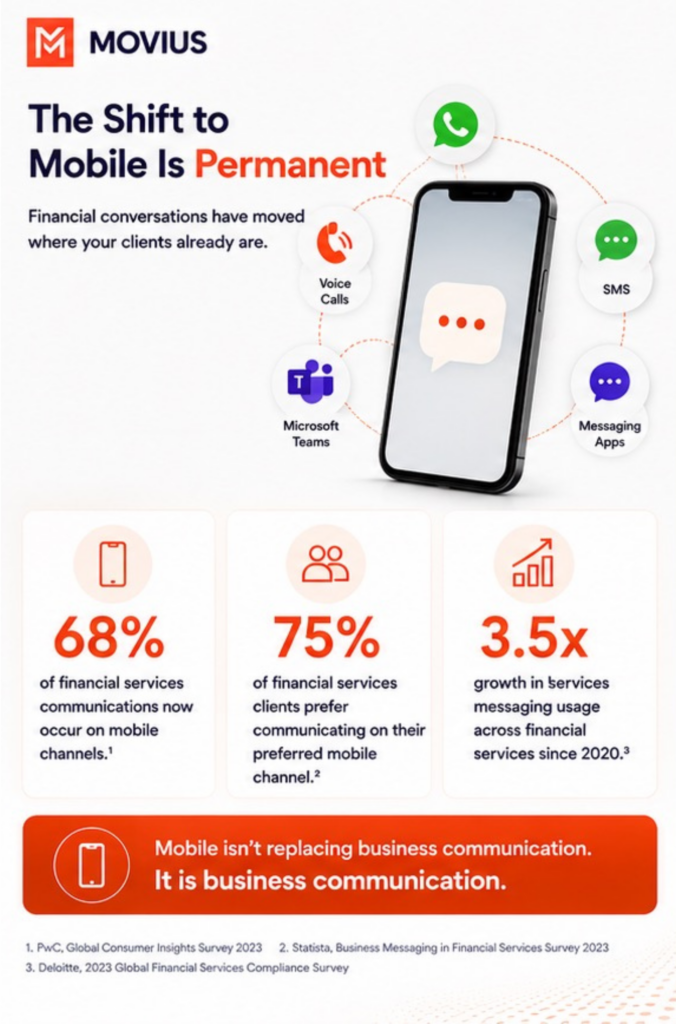
Today, relationship managers, financial advisers, traders, private bankers, and wealth managers increasingly engage clients through mobile-first communications. Whether it’s a phone call, SMS, WhatsApp, Microsoft Teams, or other messaging channels, clients expect to communicate on the platforms they already use every day.
The challenge isn’t whether mobile communication should be allowed.
It’s whether every business conversation can be governed, captured, and made available when the business, or regulators, need it.
The shift to mobile is permanent
Customer expectations have fundamentally changed.
Across North America, the UK, and global financial markets, clients increasingly expect fast, convenient, and personalized communication through mobile channels. Conversations rarely stay within a single platform. A client interaction may begin in Microsoft Teams, continue over a mobile call, and conclude with a text message or WhatsApp conversation.
Meanwhile, Microsoft Teams has become a standard collaboration platform with more than 320 million monthly active users, yet many external client interactions still occur through traditional mobile channels and consumer messaging applications.
The result is a fragmented communications environment where important business conversations are spread across multiple devices, applications, and networks.
For compliance, legal, and risk teams, visibility has become the greatest challenge.
Regulation hasn’t changed. Communications have.
Whether regulated by the SEC, FINRA, CFTC, FCA, IIROC, CIRO, ASIC, MAS, or other financial authorities, one expectation remains consistent:
Firms must retain, supervise, and produce required business communications.
What has changed is where those records now originate.
Business conversations no longer occur exclusively on corporate email systems or recorded desk phones. They happen throughout the workday across voice calls, text messages, collaboration platforms, and mobile messaging applications.
As communication channels multiply, maintaining complete and accurate records becomes significantly more difficult.
The compliance obligation hasn’t changed. The communications landscape has.
Policies alone can’t solve the problem
Most financial institutions already have communication policies. The challenge is behavior.
Employees naturally use the channels their clients prefer. Speed, convenience, and responsiveness often outweigh policy manuals when relationships are on the line.
Attempting to prohibit mobile communication altogether rarely eliminates risk.
Instead, it often pushes conversations to channels the organization cannot monitor or archive.
A more effective strategy is enabling employees to communicate through approved mobile channels that automatically support governance, supervision, and record retention—without disrupting the client experience.
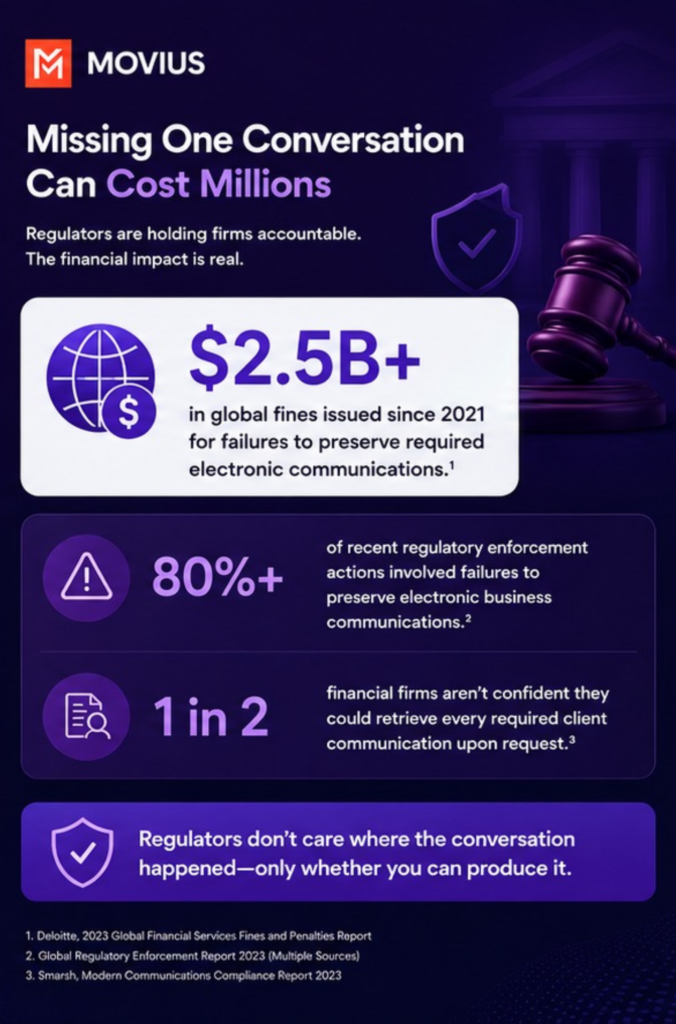
The cost of missing conversations
Regulators around the world have made one message unmistakably clear: Business conversations must be captured, regardless of where they occur.
In the last few years, financial institutions globally have faced billions of dollars in enforcement actions related to failures to preserve required electronic business communications. These cases span multiple jurisdictions and reinforce a broader industry shift: governance can no longer be limited to email and recorded phone systems.
Mobile communications have become a core component of modern compliance programs.
Building a modern communications governance strategy
Forward-looking financial institutions are no longer asking employees to change how clients communicate.
Instead, they’re modernizing how those conversations are governed.
An effective communications governance strategy should enable firms to:
- Capture business voice calls and text messages from mobile devices.
- Separate personal and business communications on employee-owned devices.
- Govern conversations across voice, SMS, WhatsApp, Microsoft Teams, and other approved communication channels.
- Archive communications for supervision, investigations, litigation support, and regulatory requests.
- Apply consistent governance policies across every communication channel.
- Eliminate reliance on manual processes or employee self-reporting.
Most importantly, compliant communication should be seamless.
The easier it is for employees to use approved communication channels, the more consistently governance happens in practice.
Compliance is only the beginning
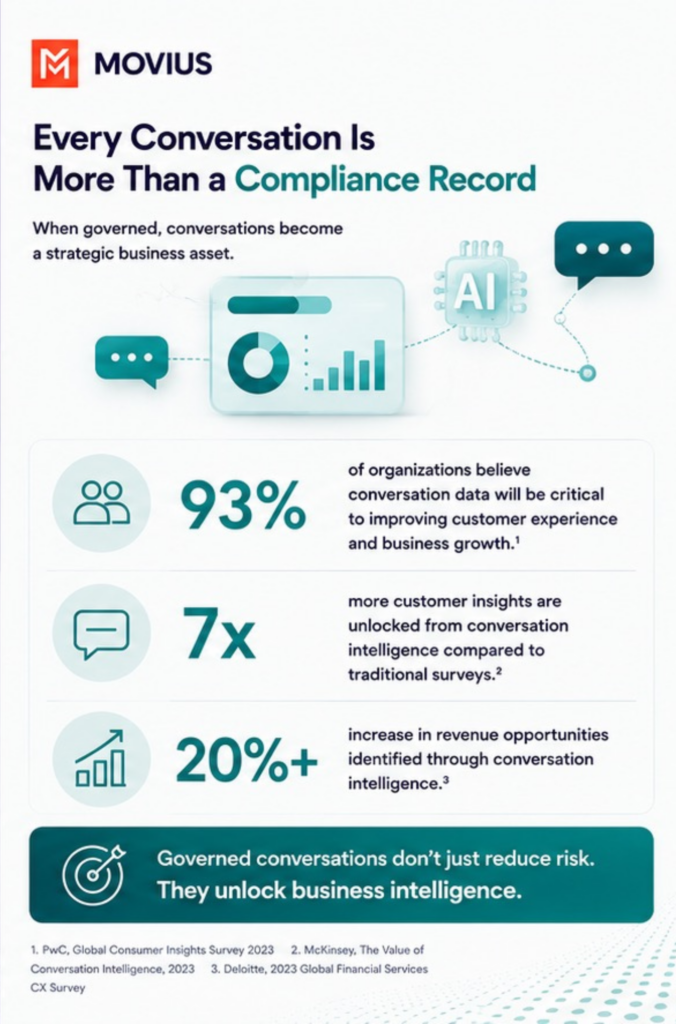
Capturing conversations isn’t simply about satisfying regulators.
Business conversations represent one of the richest, and often least utilized, sources of customer intelligence.
Every interaction contains insights into customer sentiment, emerging risks, service quality, product demand, operational challenges, and revenue opportunities. When conversations are securely captured and centralized, they become a strategic business asset that can improve decision-making, customer experience, and operational performance.
As AI and conversation intelligence become increasingly important, organizations that govern their communications effectively will also be better positioned to extract meaningful business insights from them.
Questions every financial services executive should be asking
Imagine a regulator requesting every client communication related to a specific transaction tomorrow.
Could your organization confidently retrieve every relevant mobile call, text message, collaboration chat, and messaging conversation?
Now consider a different question.
If your sales, operations, customer experience, or AI teams wanted to analyze those same conversations to identify trends, improve client service, or uncover new business opportunities, would those interactions be available in a centralized, governed environment?
For leading financial institutions, this is becoming the defining question.
The issue is no longer whether business conversations happen on mobile. It’s whether every conversation is secure, governed, and transformed into a trusted business asset.
As client communication continues to evolve, firms that align convenience with compliance and governance will be better positioned to reduce operational risk while supporting the way employees and clients actually work.
The future of financial services depends on trusted conversations. Discover how Movius helps organizations govern mobile communications, reduce risk, and unlock the intelligence within every interaction.