
Healthcare organizations have spent years investing in cybersecurity.
They’ve secured devices. Protected networks. Hardened applications. Strengthened EHR access. Built policies around patient data.
But there’s one part of the infrastructure that is still surprisingly hard to control: The conversation.
- A physician calls a patient from a hospital-issued phone.
- A nurse sends a quick text from her personal device.
- A care coordinator follows up after hours.
- A team uses Microsoft Teams to coordinate care.
The phone may be managed. The app may be approved. The network may be secure.
But here’s the real question:
Where does that conversation actually live?
And if it includes protected health information, can the organization see it, secure it, retain it, and review it when needed?
That’s where things get complicated.
The device isn’t always the answer
Most large health systems don’t have one clean device strategy. It’s rarely as simple as “everyone gets a corporate phone” or “everyone uses BYOD.”
In reality, it’s usually a mix.
Some employees have organization-managed smartphones. Others use shared devices. Physicians may use personal phones for certain workflows. Contractors, temporary staff, and specialists may all have different setups.
That creates a gap many organizations don’t see at first:
Managing the device doesn’t always mean managing the communication happening on it.
A hospital can have thousands of managed endpoints and still have patient conversations happening through channels that are difficult to capture, retain, or govern centrally.
And healthcare communication is not slowing down. Patients expect convenience. Staff need speed. Care teams often need to reach people quickly, especially when schedules change, follow-ups are needed, or care plans are moving across departments.
The issue isn’t that electronic communication is forbidden. HHS permits electronic communication with patients, including texting, when appropriate safeguards are in place.
The real challenge is making sure those safeguards exist consistently across the entire organization.
Small gaps become big risks
One clinician texting one patient may not seem like a major problem.
But scale changes everything.
Now imagine thousands of employees, across multiple hospitals, clinics, and departments, having countless patient conversations every day.
Suddenly, the organization may be dealing with:
- Conversations it can’t centrally see
- Inconsistent retention practices
- Personal and business messages living on the same phone
- Limited auditability
- Patient communication that disappears when an employee leaves
- Departments creating their own workarounds
None of this usually happens because people are careless. It happens because healthcare moves fast. People use the tools that help them get the job done.
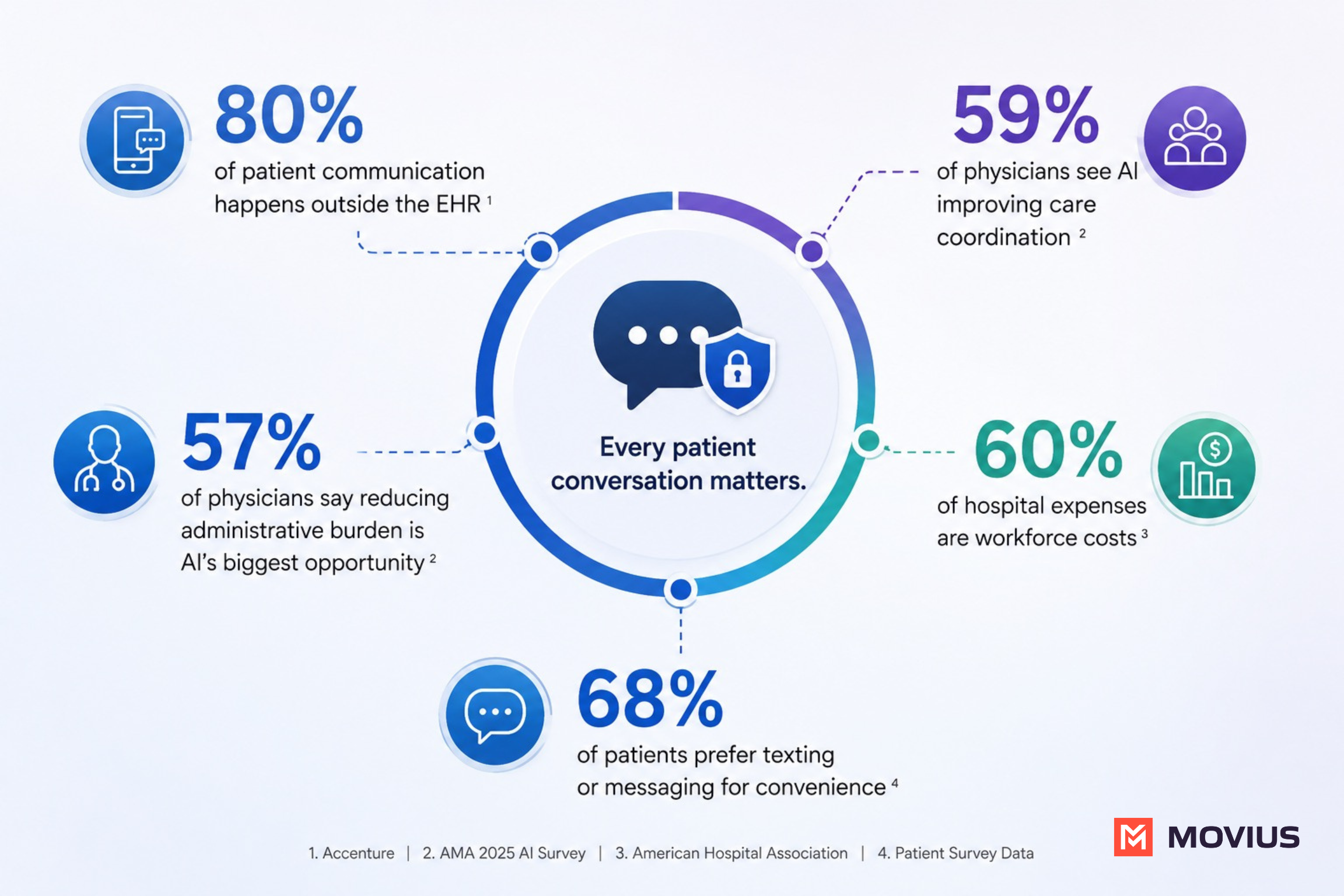
And health systems are already under pressure. According to the American Hospital Association, workforce spending accounts for roughly 60% of hospital expenses. So simply giving every employee another device is not always practical.
The better question is:
How can healthcare organizations give staff secure business communication, no matter what device they use?
Separate the business identity from the device
This is where healthcare communication needs to evolve.
Instead of tying a patient conversation to a specific physical phone, organizations can give staff a dedicated business identity.
That means a clinician can call or text from a familiar smartphone without exposing a personal number. A hospital-managed device can use the same business identity. And when an employee changes roles or leaves, the business number and communication history stay with the organization.
That distinction matters:
The device may belong to the person or the organization. But, the business identity belongs to the organization.
This gives IT, compliance, and operations teams more control without forcing everyone into the same device model.
It also makes life easier for staff. They can communicate in a way that feels natural, while the organization maintains appropriate oversight.
Secure the conversation, not just the endpoint
A modern healthcare communication strategy has to go beyond device management.
It should help organizations:
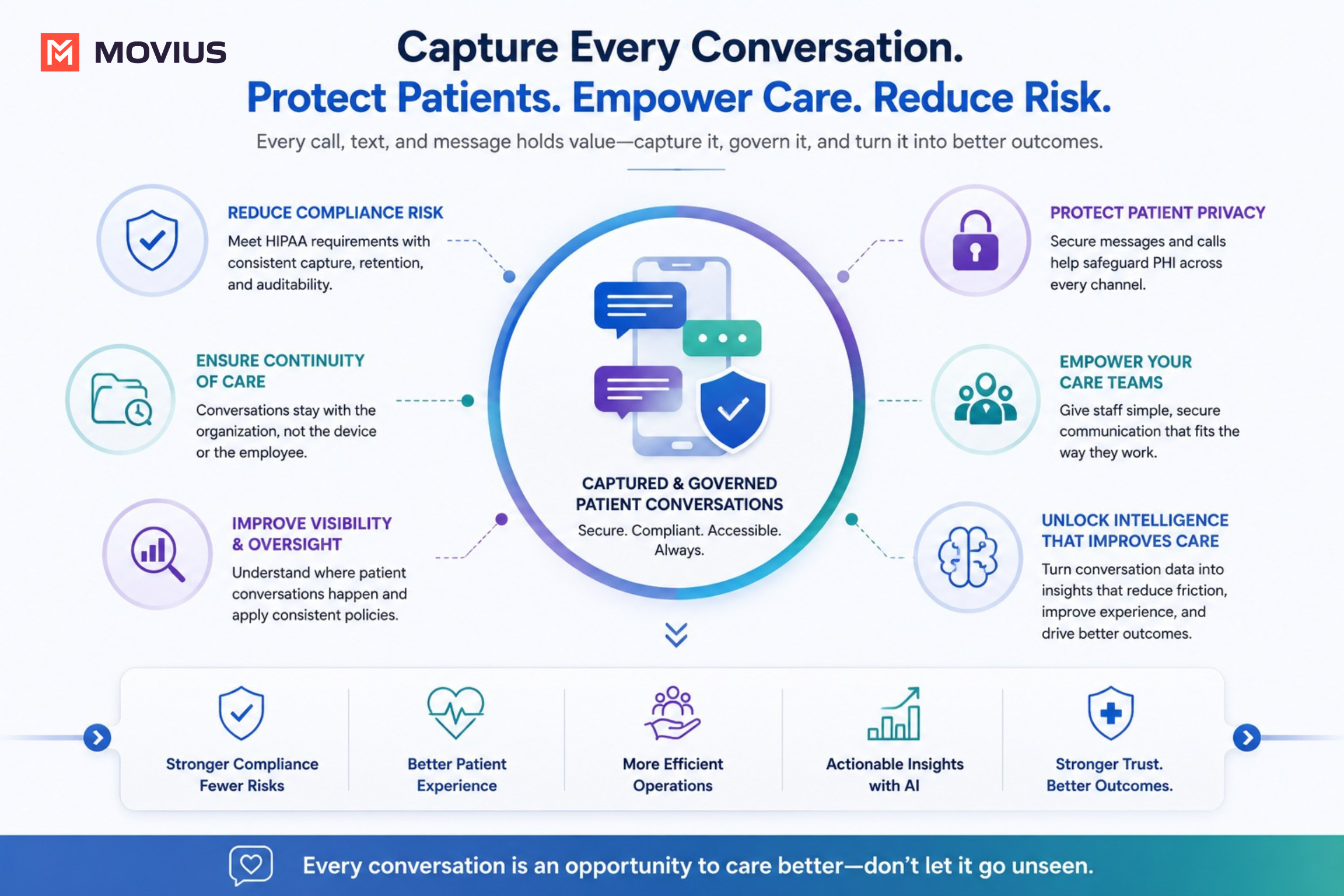
- Separate personal and professional communication
Staff should not have to give patients their personal phone numbers.
Communication needs protection, but it also needs to be easy enough that people actually use it.
- Create centralized visibility
Organizations should understand where patient communication is happening and bring it under consistent policies.
- Capture and retain what matters
Relevant conversations may need to be preserved for compliance, auditing, and continuity.
- Maintain continuity when people leave
Patient relationships should not disappear because a staff member changed jobs or left the organization.
In healthcare, a conversation is not just a message. It can be part of the patient relationship. It can contain context, reassurance, instructions, or follow-up that affects the care experience.
That makes it worth governing well.
The bigger opportunity: learning from conversations
Securing conversations is important.
But understanding them may be even more powerful.
Every day, healthcare organizations generate enormous insight through calls and messages. Patients ask questions. Staff solve problems. Care teams identify friction points. But much of that information never gets analyzed in a meaningful way.
AI is starting to change that.
In a 2025 AMA survey, 57% of physicians said reducing administrative burden was AI’s biggest opportunity, while 59% saw potential for improving care coordination.
Now imagine using conversation intelligence to understand:
- What patients are repeatedly asking about
- Where follow-ups are breaking down
- Which issues are creating unnecessary workload
- Where patients are getting frustrated
- What care teams are hearing that never makes it into the EHR
That’s when communication becomes more than something to secure.
It becomes a source of operational intelligence.
The future is not fewer conversations
Healthcare doesn’t need to stop people from communicating.
It needs to make communication safer, more visible, and more useful.
The future is not about forcing every clinician into a new device or every department into the same rigid workflow. It’s about putting the right business identity, governance, security, and intelligence layer around the conversations already happening.
Because if a conversation is part of the patient relationship, the organization should be able to secure it, govern it, and, when appropriate, learn from it.
That is the shift healthcare needs to make:
From managing devices to managing conversations.
And from simply protecting communication to making it work harder for patients, staff, and the entire health system.
Secure every patient conversation. Unlock what comes next.
See how Movius helps healthcare organizations give staff secure business communication across the devices they already use.