
Every customer relationship begins with a conversation.
Every sale, service request, investment decision, support issue, and strategic partnership is built through thousands of conversations happening every day.
Yet most organizations still view communications as separate channels, including email, voice, messaging, and collaboration platforms, instead of recognizing every business conversation as a source of valuable business data.
As work has become more distributed and customer expectations have evolved, business conversations now happen across voice, text, collaboration platforms, messaging apps, and AI-powered channels. The technology has changed.
The importance of those conversations hasn’t.
The question organizations should be asking isn’t simply whether employees have the right communication tools.
It’s whether every business conversation is secure, governed, accessible, and creating value for the organization.
Here are seven questions every executive team should be asking.
1. Do you know where your business conversations are actually happening?
Business conversations no longer begin and end with email.
Employees communicate with customers through voice calls, SMS, Microsoft Teams, WhatsApp, collaboration platforms, and other digital channels. Many conversations seamlessly move between them throughout the day.
The first question isn’t whether these channels are being used.
It’s whether your organization has visibility into where business conversations actually occur.
You can’t govern, or learn from, conversations you can’t see.
2. Are your conversations creating business value, or disappearing?
Most organizations view communications as something that happens.
Leading organizations recognize conversations as business assets.
Every interaction contains valuable insights about customers, products, operational issues, employee performance, emerging risks, and future opportunities.
If those conversations aren’t captured, governed, and connected to the business, that intelligence is lost.
The real question is: Are your conversations generating knowledge, or simply disappearing after they happen?
3. Can you retrieve the conversations that matter?
Whether the request comes from Legal, Compliance, HR, Customer Experience, or executive leadership, organizations need confidence that important business communications can be found quickly.
Consider every conversation channel:
- Voice
- SMS
- Messaging applications
- Collaboration platforms
- Customer communications
If locating those conversations depends on manually collecting employee devices or searching disconnected systems, your organization may have unnecessary risk, and unnecessary inefficiency.
4. Are employees using the tools your organization expects them to use?
Policies don’t drive behavior.
Convenience does.
Employees naturally communicate through the channels that make it easiest to serve customers and get work done.
The best communication strategy isn’t the one with the longest policy document.
It’s the one employees willingly adopt because it fits naturally into how they already work.
5. Who owns your customer relationships?
Customer relationships don’t live inside a CRM.
They live inside conversations.
If important business communications remain tied to personal numbers, individual messaging accounts, or disconnected applications, organizations risk losing valuable customer history whenever employees change roles or leave the business.
Ask yourself:
- Does the organization retain ownership of business conversations?
- Can customer relationships continue without interruption?
- Does valuable institutional knowledge remain with the business?
6. Are your governance policies keeping pace with how business actually happens?
Many governance frameworks were designed for an era dominated by email and office phones.
Today’s communications environment is dramatically different. Business happens across multiple channels, devices, locations, and increasingly, AI-powered experiences.
Governance shouldn’t lag behind employee behavior. It should evolve alongside it, protecting the organization without slowing the business down.
7. If you had to evaluate your communications strategy today, where would you be least confident?
This may be the most important question of all. Every organization has strengths, and every organization also has blind spots.
Perhaps it’s visibility across communication channels, recordkeeping, customer continuity, or governance.
Or perhaps it’s understanding how business conversations could become a strategic source of intelligence rather than simply another operational expense.
Knowing where those gaps exist is the first step toward closing them.
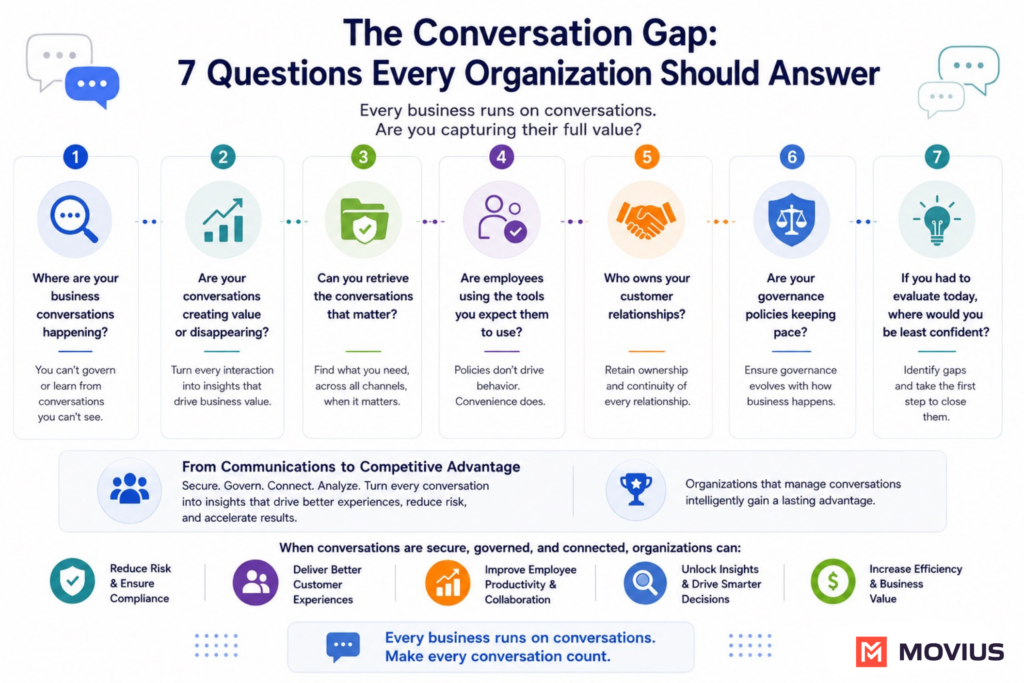
From Communications to Competitive Advantage
The organizations leading the next decade won’t simply communicate more effectively.
They’ll manage conversations more intelligently.
They’ll secure them, govern them, connect them, analyze them, and transform them into insights that improve customer experiences, strengthen employee productivity, reduce risk, and accelerate better business decisions.
Because every business already runs on conversations.
The question is whether your organization is treating them like the strategic asset they’ve become.
If these questions uncovered gaps in your communications strategy, now is the time to rethink how your organization manages business conversations. Discover how Movius helps organizations make every business conversation secure, intelligent, governed, and actionable.