
Text message archiving for financial advisors means automatically capturing every business text, iMessage and call an adviser’s staff send, and storing it so the firm can produce it. SEC-registered investment advisers must keep covered written communications for at least five years under Advisers Act Rule 204-2. That holds whether the text came from a firm phone or an employee’s own phone (BYOD).
KEY TAKEAWAYS
- Rule 204-2(a)(7) requires RIAs to keep business communications about advice, recommendations, funds and securities movements, orders, and performance.
- Retention is at least five years from the end of the fiscal year of the last entry, with the first two years in an appropriate office.
- SEC enforcement eased after January 2025, but the rule did not change, and the 2026 exam priorities treat recordkeeping as channel-agnostic.
- In a BYOD environment, the cleanest model is a separate business number on the employee’s own phone. The business line is captured and the personal side never is.
- You can keep Global Relay and other selected systems as your archive of record. The capture tool’s job is to deliver complete, threaded records into it.
What do SEC rules require RIAs to keep from text messages?
Registered Investment Advisers (RIAs) must keep originals of business communications they receive and copies of those they send, when they fall into four categories. Texts are written communications, so the rule applies to them in full.
Under Advisers Act Rule 204-2(a)(7), covered communications relate to:
- Any recommendation made or proposed, or advice given or proposed
- Receipt, disbursement or delivery of funds or securities
- Placing or executing orders to buy or sell securities
- Predecessor performance, or the performance or rate of return of managed accounts, portfolios or recommendations
How long you must keep them: at least five years from the end of the fiscal year in which the last entry was made. For the first two years, the records must sit in an appropriate office of the adviser.
How you must store them electronically: Rule 204-2(g) requires records to be arranged and indexed for easy retrieval. You must be able to produce true, complete and legible copies promptly when the SEC asks. A separate duplicate copy must be kept for the full retention period, and access must be limited to authorized people.
The RIA rule is narrower than the broker-dealer rule (Exchange Act Rule 17a-4). In practice, that difference rarely helps. No capture tool can tell, at the moment a text is sent, whether “Sounds good, let’s move it Friday” is advice. Most firms therefore capture all communication on the business line and let supervision sort it out.
Is the SEC still enforcing off-channel texting rules in 2026?
Enforcement has slowed, but the obligation is unchanged. Examiners still ask how firms capture business texts.
| Date | What happened | Why it matters to RIAs |
|---|---|---|
| Dec 2021 – Jan 2025 | SEC off-channel sweep. Roughly 60 firms charged and about $2.7 billion in fines and penalties | Set the baseline: personal-device texts are firm records |
| Apr 2024 | First case against a stand-alone RIA not affiliated with a broker-dealer | Advisers are not exempt |
| Jan 13, 2025 | 12 firms, including nine advisers, paid $63.1 million combined | The last large wave to date |
| Nov 17, 2025 | FY2026 exam priorities released | Recordkeeping is referenced throughout without naming any channel |
| May 1, 2026 | ICI asks the SEC to modernize the Advisers Act recordkeeping rule | Change has been requested, not adopted |
The practical reading: fines for missing texts are less likely today than in 2023. An exam finding that your policy says one thing while your advisers do another is still very likely. A rule change, if it comes, would take time and would not retroactively cover records you failed to keep.
How can employees text on BYOD phones without capturing their personal messages?
Give each employee a separate business identity on the phone they already own, and capture only that identity. BYOD privacy concerns come from capturing the whole device, which is where the pushback and legal risk start.
There are four common approaches. They differ most on privacy and on iMessage.
| Approach | How capture works | Personal messages exposed? | SMS / MMS | iMessage | Mobile voice | Best fit |
|---|---|---|---|---|---|---|
| Business-number app, built for BYOD (for example, MultiLine) | A second number in an app. Only that line’s calls and texts are recorded in the cloud | No. The personal number is untouched | Yes | Yes | Yes | Advisers on their own phones; mixed fleets |
| Carrier-network capture (for example, CoreLine) | Captured in the mobile network for a business SIM line. No app needed | Only if one line is used for both | SMS yes; MMS varies | No. iMessage travels over the internet, not the carrier | Yes | Firm-issued phones |
| Native-app capture (device agents or backup-based Apple Messages connectors) | Copies messages from the device or its backup | Possible, unless filtering is reliable | Yes | Yes, the main reason firms choose it | Usually separate | Firms whose clients insist on iMessage |
| Policy-only ban | Nothing is captured. Staff attest they don’t text | Not applicable | No | No | No | Rarely holds up. Examiners test practice, not policy |
For most RIAs, the business-number model gives the cleanest answer to “can compliance see my personal texts?” The answer is no, because the personal line is never in scope. It also solves a second problem: when an adviser leaves, the client relationship number stays with the firm.
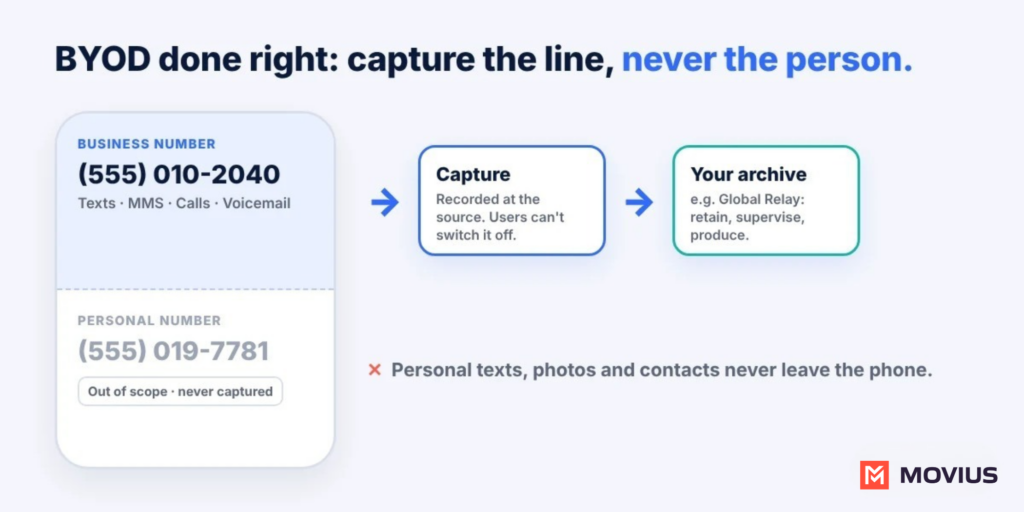
How MultiLine works on a BYOD phone
MultiLine puts a second, firm-owned business number on the phone your employee already carries. It works on any carrier, and there’s no second device to buy. Here is what each side sees.
What the employee sees
- Install and sign in. The employee downloads the MultiLine app and gets a business number assigned by the firm.
- Text and call clients from the business number. Client conversations, business contacts and voicemail live inside MultiLine, separate from personal messages. Photos and attachments (MMS) are supported.
- Set boundaries. Out-of-office auto-replies for SMS and MMS can be scheduled, so clients know when to expect a reply.
- Leave the firm cleanly. The business number and its history stay with the firm. The employee keeps their personal number, and nothing on the personal side was ever collected.
What compliance and IT see
- Capture they can’t switch off: administrators set call and message recording, and users cannot turn it off.
- Records in the archive of record: captured texts, MMS, calls and voicemail are delivered to the firm’s existing archive, such as Global Relay.
- Controls on the business side: IT can apply policies such as restrictions on copy/paste and screenshots, and can suspend a user immediately.
- Continuity: when an adviser leaves, the client-facing number is reassigned rather than lost.
The BYOD questions employees ask
| Employee question | Answer with MultiLine |
|---|---|
| Can my firm read my personal texts? | No. Only the business number is captured. Personal texts, photos and apps are never in scope |
| Do I need to carry a second phone? | No. The business number runs on the phone you already own |
| What if I change carriers? | It still works. MultiLine runs regardless of the underlying carrier |
| Will clients see my personal number? | No. Clients only ever see the business number |
| What happens if I leave? | The business number stays with the firm. Your personal number and data stay with you |
Can iMessage be archived for SEC compliance?
Yes, but not through Apple. Apple offers no native tool to archive iMessage conversations, and iMessage is end-to-end encrypted. Every iMessage archiving method therefore works around the device or the Apple ID.
There are three things to get clear before you commit:
- Which Apple ID is captured? If it is the adviser’s personal Apple ID, you are capturing their personal life too. Ask how personal threads are filtered out, and who can see them before filtering.
- What happens when the client is on Android? The conversation falls back to SMS or RCS, which may run through a different capture path. Check that both land in the same thread in your archive.
- Do you need native iMessage at all? Many firms find clients accept a business number that shows up as a standard text. That keeps the whole conversation on one captured line. Ask each vendor to show how its business line appears on a client’s iPhone.
How does mobile capture work with Global Relay as your archive of record?
The capture tool and the archive are two separate layers. You do not need to replace Global Relay to add compliant mobile texting. The capture layer records the conversation, and the archive layer retains, supervises and produces it.
Global Relay Archive accepts third-party communications through its Open Connector API and secure SMTP delivery. Movius exports captured MultiLine records to the archive a firm already uses. Movius also integrates with compliance platforms including Theta Lake, NICE NTR-X and 17a-4’s DataParser.
When you test any capture vendor against your Global Relay tenant, check these six things:
- Threading: a 40-message exchange arrives as one conversation, not 40 emails.
- MMS: images and PDFs arrive as attachments, searchable by file name.
- Identity mapping: each message maps to the right employee, even after a number is reassigned.
- Voice: call recordings and voicemail arrive with caller, callee, time and duration metadata.
- Latency and gaps: you get delivery confirmations or reconciliation reports that prove nothing was dropped.
- Offboarding: records from a departed adviser keep flowing until the line is closed.
What should capture, retention, supervision and eDiscovery look like end to end?
Each stage has one owner and one test. Failures usually happen in the handoffs between stages, not inside any one tool.
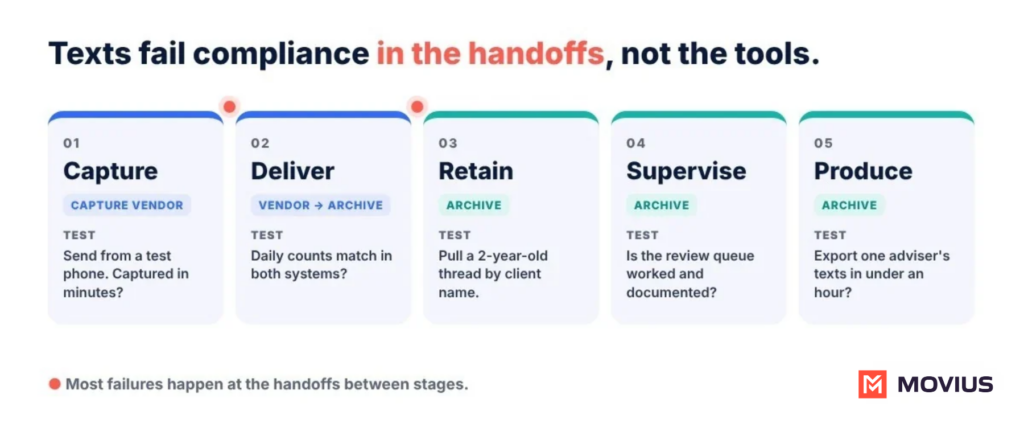
- Capture (capture vendor): Business texts, MMS, calls and voicemail are recorded at the source. Users cannot switch recording off.
Test: Send a text from a test device and confirm it is captured within minutes. - Deliver (capture vendor to archive): Records move into Global Relay with metadata intact.
Test: Compare daily counts between the two systems. - Retain (archive): Records are kept for at least five years, indexed, with a duplicate copy and access controls, per Rule 204-2(g).
Test: Retrieve a two-year-old thread by client name. - Supervise (archive): Lexicon or AI review flags risky language such as guarantees or off-channel nudges like “text me on my other phone.”
Test: Is the review queue reviewed and documented? - Produce (archive): You can run eDiscovery exports and legal holds for exams, litigation or client complaints.
Test: Could you export one adviser’s texts for a date range in under an hour?
The RIA mobile capture demo scorecard
Use these questions in every vendor demo. They cover the full evaluation an RIA compliance team typically runs.
| Area | Ask the vendor | A strong answer |
|---|---|---|
| BYOD deployment | How is the business line installed on an employee’s own phone? | App-store install, SSO, and optional MDM. No access to personal data |
| Separation | Can compliance ever see personal texts, contacts or photos? | No. Only the business line is in scope, and this is shown technically, not just promised |
| SMS / MMS | Are group texts and attachments captured? | Yes, threaded, with attachments preserved |
| iMessage | How does the business line appear to iPhone clients, and what is captured? | A clear, demonstrated answer, including Android fallback |
| Voice | Are calls and voicemail recorded too? | Yes, on the same business identity |
| Global Relay | Show a captured thread arriving in our tenant. | Live or recorded proof, plus reconciliation reports |
| Retention | Who holds the record of truth, and for how long? | Your archive holds it for at least five years. The vendor’s copy follows your policy |
| Supervision | Can we flag messages before they reach the archive review queue? | Policy alerts, or a clean handoff to your archive’s surveillance |
| eDiscovery | How do we produce one adviser’s texts for an exam? | Search and export in your archive, within minutes |
| Admin controls | Can users turn off recording, copy text out, or delete messages? | No. Recording is admin-set, and copy/paste and screenshot limits are available |
| Offboarding | What happens to the number when an adviser leaves? | The number stays with the firm and can be reassigned |
| Security | Which audits and certifications apply? | SOC 2 Type 2 report, encryption in transit and at rest, customer-managed keys |
| Pricing | What is included per user, and what is extra? | Capture channels, archive delivery and support spelled out up front |
What does implementation involve, and how is pricing structured?
Most of the work is policy and testing rather than technology. The steps run in this order:
- Update your policies and procedures to name the approved texting channel, and train staff on it.
- Decide on numbers. Issue new business numbers, or port existing ones advisers already give clients.
- Connect identity. Set up SSO or directory sync, and MDM if you use it.
- Configure archive delivery into Global Relay and test it with real threads, MMS and calls.
- Pilot with a small team and reconcile counts daily.
- Roll out with attestations, then review the supervision queue weekly for the first month.
Pricing for mobile capture is usually a per-user subscription. It varies with the channels you capture (SMS/MMS, voice, WhatsApp), the number of users, and the archive integration. Remember that your archive may charge separately for ingesting new data types. Ask for a quote that covers both sides, so the total cost of ownership is clear.
Where Movius fits
Movius was built for BYOD. It gives RIAs a compliant business line on the phones advisers already carry, so the firm doesn’t have to buy, ship or manage a second device.
- MultiLine adds a second business number to an employee’s existing smartphone, on any carrier. Business calls, messages, contacts and voicemail stay separate from personal ones. It supports voice, SMS, MMS and WhatsApp on the business identity.
- Admin-controlled capture: administrators set call and message recording, and users cannot turn it off. Mobility policies can restrict copy/paste and screenshots (security details).
- Archive delivery: captured records go to your existing archive, so Global Relay stays your system of record.
- CoreLine captures calls and SMS on firm-issued SIM-based phones with no app, in partnership with T-Mobile and TELUS in the US and Canada.
- Security: an annual SOC 2 Type 2 examination, FIPS 140-2 Level 3 HSMs with customer-owned encryption keys, and FedRAMP and GovRAMP authorization.
Book a walkthrough built around your current archiving setup (e.g., Global Relay). We’ll show a captured thread arriving in an archive and cover your BYOD deployment, capture and pricing questions.
Frequently Asked Questions
Do RIAs have to archive text messages?
Yes, when the texts relate to advice, recommendations, funds or securities movements, orders, or performance. Advisers Act Rule 204-2(a)(7) covers written communications, and texts count. Because a tool cannot judge content at the moment a text is sent, most firms capture every message on an approved business line and use supervision to review it.
How long must an investment adviser keep text messages?
At least five years from the end of the fiscal year in which the last entry was made, under Rule 204-2(e)(1). For the first two years, the records must be kept in an appropriate office of the adviser. Electronic records must be indexed, duplicated, protected from alteration, and producible promptly when the SEC asks.
Can financial advisers text clients from their personal phones (BYOD)?
Yes, if the firm captures and retains those business texts. The safest BYOD setup is a separate business number on the employee’s own phone that is captured automatically. The adviser’s personal number and messages stay private and out of the archive. A policy that bans texting is hard to enforce, and examiners test what advisers actually do.
Can iMessage be archived for SEC compliance?
Yes, but Apple provides no native archiving tool, and iMessage is end-to-end encrypted. Firms either use connectors that copy messages from the device or its backup, or move client texting to a captured business line. Before you choose, check whose Apple ID is captured and how personal threads are excluded.
Can we keep Global Relay as our archive and use a different texting tool?
Yes. Capture and archiving are separate layers. Global Relay Archive accepts third-party data through its Open Connector API and secure SMTP delivery. Ask any capture vendor to demonstrate threaded texts, MMS attachments and call recordings arriving in your tenant, along with reconciliation reports.
Is BYOD compliant for SEC-registered investment advisers?
Yes. The SEC rules don’t ban employee-owned devices. They require the firm to capture and keep business communications from whatever device is used. A BYOD program is compliant when every business text and call runs through a captured business line, the policy names that line as the only approved channel, and the archive can produce the records on request.
Will compliance be able to see my personal texts?
Not with a business-number app. Only the business line is captured, so personal texts, photos and contacts are never in scope. Whole-device or backup-based capture is different. Ask the vendor exactly what is collected before filtering, and who can access it.
Is the SEC still fining firms for off-channel communications in 2026?
Large off-channel settlements have paused since the January 2025 wave of $63.1 million across 12 firms. However, Rule 204-2 is unchanged, and the SEC’s 2026 exam priorities treat recordkeeping as channel-agnostic. Examiners still ask how texts are captured, and a gap between policy and practice remains an exam finding.
How much does compliant text message archiving cost?
Most mobile capture tools are priced per user per month. The price depends on the channels captured (SMS/MMS, voice, WhatsApp) and the archive integration. Your archive may also charge for ingesting new data types. Ask for a combined quote covering capture, delivery, archive ingestion and support.
Evaluating mobile capture for your RIA? See MultiLine with your Global Relay workflow. We’ll walk through BYOD deployment, separation of business and personal messages, supervision and pricing in one session.