
In today’s workplace, communication is no longer centralized; it’s fragmented across email, chat apps, phone systems, social platforms, and collaboration tools. While each serves a purpose, the cumulative effect is often inefficiency, distraction, and lost productivity.
Modern organizations are now rethinking this approach. Instead of adding more tools, they are consolidating communication directly into platforms employees already use every day, most notably Microsoft Teams.
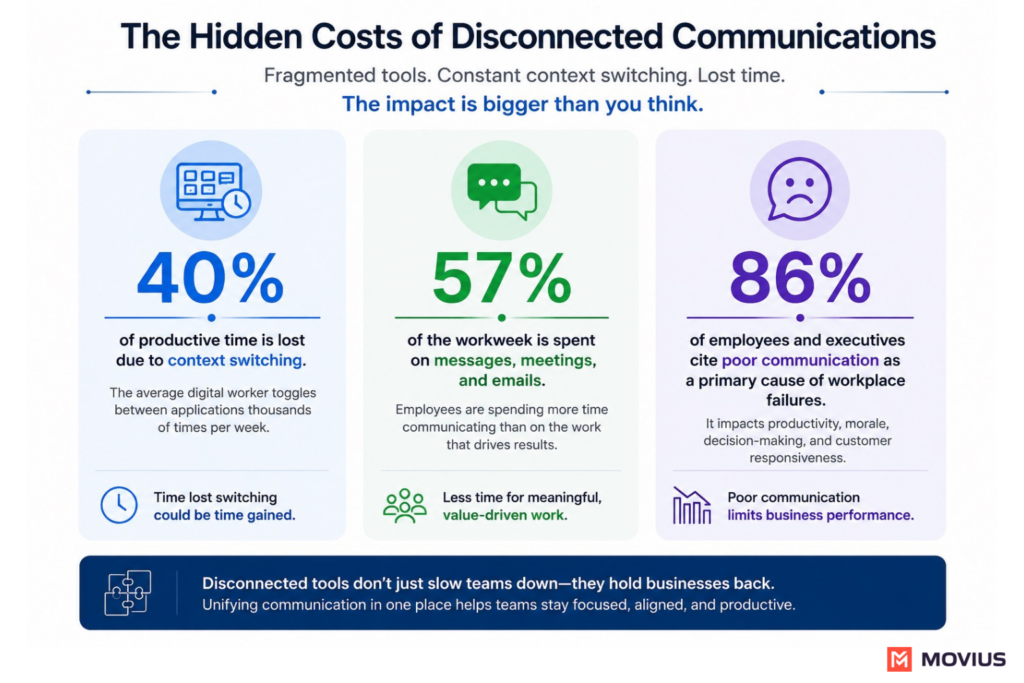
The hidden costs of disconnected communications
Most businesses underestimate just how much time is lost switching between tools. The average digital worker toggles between applications thousands of times per week, with context switching consuming up to 40% of productive time.
Additionally, employees spend an increasing share of their workweek simply communicating, spending up to 57% of their time on messages, meetings, and emails. That leaves less time for meaningful, value-driven work.
This fragmentation doesn’t just impact productivity; it affects morale, decision-making, and customer responsiveness. In fact, 86% of employees and executives cite poor communication as a primary cause of workplace failures.
Why Teams has become the center of gravity
With more than 320 million daily users globally and adoption across 93% of Fortune 100 companies, Teams has become the digital backbone for collaboration.
But its real value isn’t just in meetings or chat; it’s the ability to bring multiple communication channels into a single, integrated experience.
Organizations that leverage Microsoft Teams as a unified communication hub are seeing measurable results:
- Employees can access messaging, meetings, files, and workflows in one place.
- Communication context is preserved across interactions.
- Decision-making accelerates because information is easier to find and act on.
This shift reflects a broader enterprise trend toward consolidating communication, collaboration, and business workflows into a single digital workspace.
Extending beyond internal collaboration
One of the most important and often overlooked evolutions is how Teams is extending beyond internal collaboration to support external communication with customers, partners, and vendors.
Instead of forcing employees to jump between devices and apps, organizations are increasingly enabling outreach directly within their primary workspace. This includes:
- Voice calls with customers and partners without leaving Teams.
- Business text messaging for faster, more conversational engagement.
- Social and messaging channels that meet customers where they already are.
By bringing these external interactions into the same environment, businesses maintain full conversation context. A customer thread doesn’t live in one app while internal discussions happen in another; everything becomes part of a single, continuous workflow.
This shift is critical. Customers increasingly expect immediacy and consistency across channels, and businesses that can respond without delays or lost context gain a measurable advantage.
Turning communication into a competitive advantage
When businesses centralize both internal and external communication within Teams, the impact extends across the organization.
- Faster, more responsive engagement
Teams can respond to customers in real time across channels, reducing delays and improving the overall experience. - Reduced operational friction
Employees no longer need to track conversations across multiple systems, minimizing duplicated work and missed information. - Improved productivity and focus
Unified communication tools can save employees over five hours per week and increase collaboration efficiency by 30%. - Greater visibility and control
With conversations centralized, organizations gain better oversight, helping support governance and compliance requirements.
From tool adoption to workflow transformation
The biggest opportunity for businesses isn’t simply adopting collaboration tools—it’s transforming how work happens inside them.
Despite widespread adoption, studies suggest that 97% of teams are still underutilizing digital collaboration capabilities, leaving significant efficiency gains untapped.
Leading organizations are closing this gap by:
- Embedding communication directly into workflows.
- Reducing reliance on siloed apps.
- Enabling employees to manage both internal collaboration and external engagement from one place.
The result is a more connected, responsive, and productive workforce.
The path forward
As hybrid work becomes the norm, the volume and complexity of communication will only continue to grow. Businesses that succeed will be those that simplify—not expand—their communication landscape.
Microsoft Teams is increasingly serving as that foundation: a single workspace where conversations, collaboration, and workflows converge, internally and externally.
For organizations looking to improve efficiency, the question is no longer whether they have the right tools; it’s whether those tools are working together in the right way.
By reducing friction, consolidating channels, and meeting both employees and customers where they already are, businesses can unlock faster execution, stronger relationships, and better outcomes.
Ready to unlock the full value of Microsoft Teams?
Extend Microsoft Teams with secure voice, SMS, and customer messaging using Alloy. Keep every customer conversation connected, compliant, and accessible—all from the workspace your teams already use.
Explore Alloy → | Let’s Connect →