
“Ben, Are we saying it’s my job mate so I can start getting organized mate”
This question, posed by Steve Fincham (of Fincham Demoltion via WhatsApp to Ben James (of Jaevee Homes) became the key centerpiece in the courtroom of Jaevee Homes vs Fincham.
“Yes” James replied.
Here’s the full conversation:
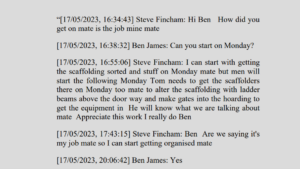
The court ruled this was legally binding and Jaevee Homes’s failure to issue payless notices meant they were liable to pay the sums claimed by invoices starting on May 17th of 2023.
Construction is a fast-paced industry, and more and more contractors, companies, and employees are choosing to communicate on the platforms they know best – that means WhatsApp and text messaging. This is opening many potential lanes for miscommunication and now legal ramifications.
In this case, Jaevee Homes argued that no true lawful agreement had occurred when the WhatsApp messages had been sent, and therefore the payless notices that they had failed to issue were not actually lawfully binding in the intervening period between the WhatsApp messages and the detailed contract submitted. In their view, the actual payment periods had started 9 days later, on May 26th – which was the date that they had sent the detailed contracts.
The court, however, sided with Mr. Fincham, who believed that the job had started when the WhatsApp messages above had been sent.
This court ruling should make anyone used to using these platforms to conduct business pay attention. As this decision illustrates, even informally worded messages can be ruled legally binding under the right circumstances.
Here are two key things to be aware of:
1. If your messages contain anything that sounds like an agreement on key terms – think things like price of an asset or hours, invoice, scope of a project, or a timeline – then it may be ruled that those are legally binding terms in a court of law.
2. You want to be precise as much as possible when discussing business terms over any platform. Anything over WhatsApp, email or text messaging should be treated with the same care as a legal document.
This is where it can help to have a tool that keeps all of these exchanges documented. In the unlucky few cases of unclear communication that leads to these sorts of disagreements, you want to have the record in a clear, undisputed view of the court. Tools like MultiLine by Movius, which provide built-in mobile recording and archival integrations for a clear, comprehensive auditable trail, can be essential to your business in 2026 and beyond.